Echoes in Silence
She lost the world in layers.
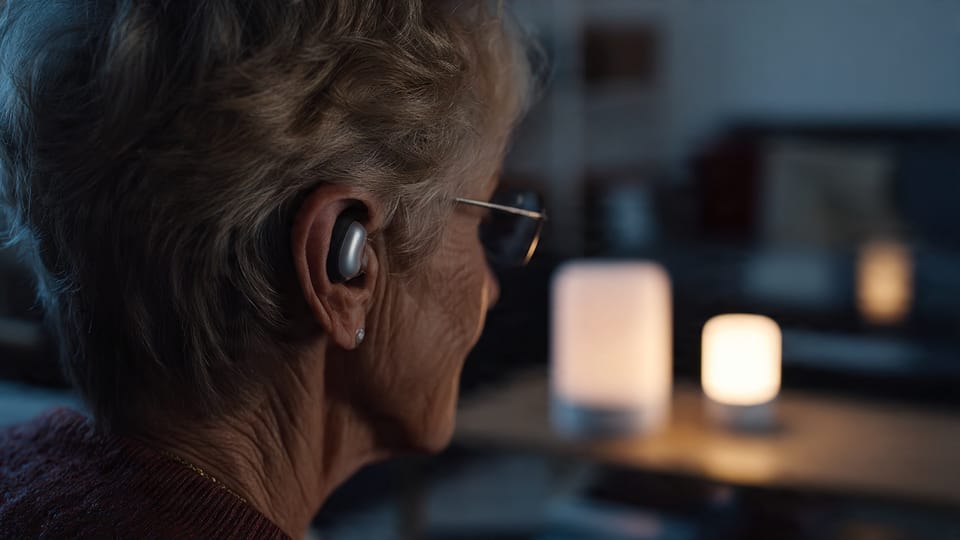
First the TV had to go louder. Then the grandkids’ voices blurred into the air conditioner. Then Sunday sermons became shapes in the pastor’s mouth, not sound in her ears. By the time her daughter convinced her to get hearing aids, most conversations felt like watching a movie on mute with bad subtitles.
The night the voices started, the apartment was so quiet it hummed.
THE SOUND THAT ARRIVED AFTER HEARING LEFT
It started as music she couldn’t quite place.
A thin choir, far away, like someone had left a radio on two rooms over. She pulled her hearing aids out, checked them, checked the TV, checked the hallway. Nothing. The building in Florida where she lived was old, but the walls weren’t that thin.
Then the lyrics came into focus.
They weren’t any song she knew. Just fragments of phrases in English that didn’t make sense together, as if someone had taken bits of talk radio, commercials, and church hymns and spliced them into one track. She could hear breaths between words. She could hear the rhythm of sentences. She could not find a source.
The worst part was this: if she turned the hearing aids off, the voices got louder.
WHAT HER BRAIN DID WITH THE SILENCE
Her daughter assumed it was loneliness.
“Mom, you’re alone too much,” she said on FaceTime, half yelling into the phone out of habit. “You sit there all day, no TV on, no one around. Of course your brain is getting weird.”
Her son assumed it was dementia.
“She’s eighty,” he said. “Hearing things? Talking about choirs in the bathroom? That’s how it starts.”
In the comments sections and short videos that float through American phones in 2026, this exact story gets recycled with different endings:
a haunting, an angel choir, dead relatives trying to make contact in the “frequencies” only the elderly can hear. It gets more likes that way.
She had grown up on ghost stories too. That first week, she prayed. Louder than she’d prayed in years. The voices did not care. They kept talking over her.
What she was living in had a name. Just not the ones her friends used.
THE CLINIC WHERE NO ONE COULD HEAR IT
In the audiology booth, her world was reduced to beeps and button presses.
Pure-tone testing confirmed what her life already knew: a significant sensorineural hearing loss, especially in the higher frequencies that carry consonants and make speech crisp. To understand everyday conversation, she needed sound turned up to levels that would have made her younger self wince.
When I met her in clinic, I asked what people had already suggested.
“Depression. Grief. God,” she said. “My neighbor thinks it’s spirits. My son thinks it’s ‘losing my marbles.’ No one has put ‘ears’ and ‘voices’ in the same sentence except to say ‘but your ears barely work.’”
The exam was otherwise unremarkable. She was oriented. Her memory, while slower, was not collapsing. She knew the date, the president, the rent, the names of every grandchild. She did not believe the television was talking directly to her. She had no other hallucinations in the visual or tactile world. The voices were episodic, clearly “not real” to her, frightening but not commanding.
And they were better in noise.
“When the dishwasher is on, when the TV is low, when I run the bathroom fan, they back off,” she said. “When it’s quiet, they move in.”
That detail mattered.
THE BRAIN HATES A VACUUM
Our sensory systems grew up in a world that rarely shuts up.
When input drops too low for too long, the brain doesn’t politely accept silence. It fills it. People with significant visual loss can see formed images, faces, patterns that aren’t there. People with missing limbs can feel fingers that no longer exist. People with profound hearing loss can hear music, voices, radio-like streams that no speaker is producing.
There is a family of syndromes built around this principle: when a sense is deafferented, the cortex that once processed rich input begins to generate its own content. Visual Charles Bonnet syndrome is the best known. The auditory variant is less famous and more stigmatized, because “seeing things” in the context of blindness sounds poetic, while “hearing voices” sounds like psychosis.
In her, severe hearing loss had quietly starved her auditory cortex for years. The hearing aids helped, but not enough to satisfy a system used to decades of constant noise. Cortical networks tuned to speech and music began to fire spontaneously, recycling traces of old inputs and stitching them into new sequences.
It didn’t feel like memory. It felt like a radio she hadn’t asked for.
NOT PSYCHOSIS, NOT POSSESSION
When you tell an eighty-year-old in America that the voices she hears are “hallucinations,” you have to be precise.
“It doesn’t mean you’re ‘crazy,’” I said. “It means your brain is creating sound in the absence of external sound, because the wiring expects input and isn’t getting enough. The fancy term is an auditory Charles Bonnet–like syndrome. Some people call it musical ear syndrome. It sits at the crossroads of neurology and audiology.”
“So this is my ears… missing things?” she asked.
“Your ears and the parts of your brain that listen,” I said.
We went through the differential anyway, because you do not get to skip steps just because one explanation fits the story well.
Could depression do this? Possibly, but she had no other major depressive features.
Could a primary psychotic disorder present this late? Rarely, and usually with paranoia and impaired insight, which she lacked.
Could a structural lesion, like a brain tumor or stroke, produce auditory hallucinations? Yes, but her imaging and neuro exam didn’t point there.
What she had was isolated, insight-preserved, strongly tied to quiet environments and severe bilateral hearing loss.
The risk now was not that we’d miss schizophrenia. It was that someone would throw antipsychotics at her for a sensory-deprivation phenomenon and leave the hearing loss untouched.
WHAT HELP LOOKED LIKE WHEN THE NOISE WASN’T “OUT THERE”
There was no exorcism. There was sound.
The first line interventions were almost insultingly simple on paper:
optimize the hearing aids, keep a low-level sound source in the background, avoid absolute silence. Small fans. Soft music. TV whispers. Sound machines that play rain or static. Enough real input to occupy the cortex so it doesn’t invent its own programming.
We adjusted her devices. Audiology fine-tuned gain, compression, and noise reduction so speech and environmental sounds came through more clearly. That alone, in many patients, can dramatically reduce hallucinations, because the brain is suddenly busy again.
We built her a “night plan.”
- Never sit in a dead-quiet room.
- Keep a low TV channel, radio, or white-noise app running.
- If voices get loud, deliberately add external sound instead of falling still and listening for them.
In some cases, meds used for mood or seizures can help tamp down cortical hyperexcitability. We discussed that as a second-line option if sound strategies weren’t enough.
They were not magic. But they were something.
HOW IT FELT FROM THE INSIDE
The hardest thing for her was the shame.
“People my age joke about forgetting names,” she said at follow-up. “They don’t joke about the choir in the bathroom.”
She described the voices in detail: sometimes singing nonsense syllables, sometimes reciting what sounded like old commercials, sometimes drifting into half-prayers in a tone that reminded her of her own grandmother. There was no clear language telling her to hurt herself or others. No running commentary on her actions. Just an unwanted soundtrack.
“They feel like neighbors with the TV on too loud,” she said. “But the wall is inside my head.”
As we optimized her hearing and sound environment, the episodes changed.
They became shorter, less frequent. The voices slid from the foreground to the edges of her awareness, like a TV in another apartment. She still heard them most on nights when the power went out and the house fell absolutely still.
On those nights, she stopped praying for them to leave and started doing something that looked, from the outside, almost ridiculous: she’d turn on a weather radio or play a podcast on low through her phone.
“If I give my brain something real to listen to,” she said, “the fake people get bored.”
That shift—from haunted to managing a misbehaving cortex—is what actually matters.
WHY THIS MATTERS OUTSIDE HER APARTMENT
If you scroll long enough, you’ll find thousands of older Americans talking about this in code.
“I hear music at night, but no one else does.”
“I hear a radio in the walls.”
“I hear voices but I know they’re not demons.”
Too often, they stay quiet in clinics, afraid that saying the word “voices” will trigger a psych label, a prescription, a loss of autonomy. Too often, clinicians forget that hearing loss itself can generate hallucinations, assuming any reported voice must live in psychiatry, not in a deprived auditory cortex.
The cost is simple: people suffer in silence that isn’t really silent.
Her case wasn’t rare. It was just finally named.
In the end, nothing supernatural ever moved into her apartment the only thing that started talking when the world went quiet was the part of her brain that could not bear the sound of its own silence.
Soren Whitlock