The Walking Curse
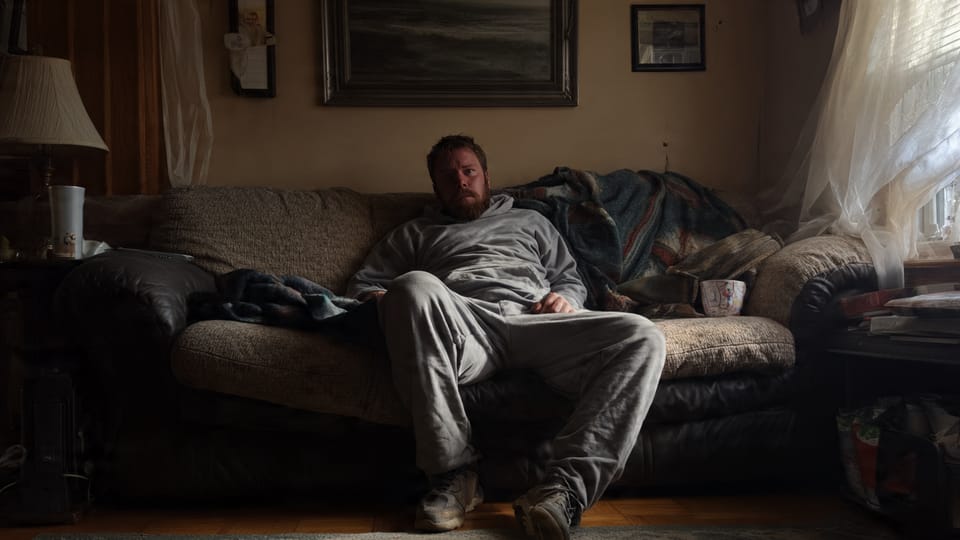
The weakness didn’t stay where it started.
It slid.
From his right foot to his calf, from his calf to his thigh, from one side of his body to the other like something invisible was walking through him, turning muscles off as it passed. By the time he hit the ER, he could still move his face, still scroll on his phone, still unlock his Tesla to pay for downtown parking. He just couldn’t trust his legs to carry him back to the car.
HOW THE CURSE BEGAN
He worked nights at a warehouse outside Dallas, the kind that ships everything people order at 2 a.m. when they can’t sleep and think buying things will help.
The first time it happened, it was January cold in the loading bay. He bent to lift a box and his right foot didn’t push back. It felt heavy, thick, like he was stepping into mud that only he could feel. The weird part wasn’t that his leg was weak. The weird part was that fifteen minutes later, it wasn’t.
Over the next weeks, the pattern got stranger.
Some mornings he woke up and his left hand wouldn’t close around his coffee mug. By lunch it was fine and his right thigh felt like it belonged to somebody else. Once, halfway through a Costco run, both legs gave out just enough that he had to sit down between the seasonal aisle and the free sample table, pretending he was checking his phone while his body rebooted.
Friends told him to get his electrolytes checked, drink less energy drink, eat something that wasn’t drive thru. He did. The spells kept coming.
THE WALKING STORY
His mother had another explanation ready long before neurology did.
“This is how your uncle started,” she said on FaceTime from El Paso. “First it was the arm. Then the leg. Everything moving around. We called it a curse, remember? Something that walks through the body.”
In her version, whatever it was had wandered from limb to limb before “settling.” Back then, no one had money for MRIs or gene panels. You called the priest. If he couldn’t fix it, you called it fate.
It didn’t help that TikTok in February 2026 was flooded with stories of “mysterious paralysis” and “people waking up unable to move,” videos where someone lay still in bed with text over their body explaining how their doctor “found nothing” and the comments filled with angel numbers, manifestation advice, and warnings about dark energies.
He watched them at 3 a.m. on his breaks, his legs buzzing, the algorithm happily feeding him more.
By the time his girlfriend found him dragging himself up the six steps to their apartment, pulling on the railing with both hands while his right leg refused to lift, the word she used was not “stroke.”
“You’re cursed,” she said, half joking, half not. “Whatever this is, it’s moving.”
UNDER THE FLUORESCENT LIGHTS
In the ER, he was triaged like every other “weakness” in America.
CT head. Basic labs. EKG. His face moved, his speech was fine, his reflexes mostly cooperated. By the time imaging came back normal, the worst of the weakness had shifted again. The right leg he couldn’t move on the steps now did what he told it to. The left felt… off, but not enough to impress anyone.
“You’re walking,” one resident said, watching him cross the hallway with a slightly uneven gait.
“I wasn’t walking thirty minutes ago,” he answered.
The notes called it “episodic weakness.” The neurology consult was called “to rule out weird things.”
This is the part of the story where medicine has to decide which kind of ghost it is dealing with.
A CHANNEL THAT MISFIRES
One category of “walking paralysis” lives deep in the muscle, in the ion channels that control how muscle fibers turn electrical signals into movement.
Periodic paralysis. Inherited channelopathies where calcium or sodium channels in skeletal muscle go just wrong enough that, under certain triggers, fibers stop responding and power down. Episodes can last minutes to hours. They can move. They can look exactly like something is traveling through a person’s body, even though the real movement is shifts in potassium, in channel states, in membrane excitability.
Ask the right questions and you start to see it.
Do the attacks come after rest following heavy exercise? After a high carb meal? After a long time sitting still, like those endless commutes where you’re stuck on I 95 praying traffic will move? Do they get better or worse with certain foods, with potassium, with cold?
In his case, the timing lined up almost too well.
Overnight shifts with long periods of standing still, then suddenly sitting in his truck scrolling his phone and inhaling fast food. Sugar spikes. Insulin surges. Blood potassium dropping just enough in the hours after to push his genetically suspect channels into the wrong configuration. The weakness “walking” from one group of muscles to the next as some fibers failed and others compensated.
The labs caught one episode with potassium lower than it should have been. It wasn’t dramatically abnormal, but in the context of his symptoms, it was a clue. Genetic testing later would call it by its longer, colder name.
Hypokalemic periodic paralysis.
THE OTHER KIND OF GHOST
There was another possibility lurking in the differential that fit the “moving curse” language in a very different way.
Functional neurological disorder. FND. A problem with how brain networks generate movement, not with the hardware of nerves and muscle, where weakness and paralysis can appear, shift, and even spread with a logic that maps more to stress and attention than to anatomy. It’s common, more common than most clinicians realize, and January and February 2026 had already seen threads full of young people sharing stories of sudden inability to walk after watching months of content about tics, paralysis, and rare diseases.
In FND, scans are normal. Reflexes are often preserved. Strength may be full when tested one way and absent when tested another. The symptoms are real, disabling, and often terrifying, but arise from software level changes in brain networks rather than structural damage.
His exam didn’t behave like that.
When his leg went, it went. Reflexes faded with it. Salt and carbs changed his trajectory. Potassium nudged him back. His episodes woke him up at 5 a.m. after pizza in front of a Twitch stream, not after fights or grief or panic. The curse had rules, biochemical ones.
TELLING HIM WHAT IT WAS
We sat in a curtained bay with the noise of the waiting room bleeding through the fabric.
“This looks like a muscle channel problem,” I told him. “There’s a rare group of conditions where your muscle fibers, under the wrong conditions, stop responding to the signals your nerves send. It comes in attacks. It can move. It can be triggered by exactly the kind of nights you’ve been having.”
“So it’s not… something walking through me.”
“It is something,” I said. “Just smaller than you were picturing.”
I explained potassium, channel mutations, why his uncle might have had the same thing and never known. How, in older days, these episodic paralyses looked like possessions or curses because they arrived out of nowhere and broke normal rules.
He listened, fingers twitching on the edge of the bed.
“So the ghost is in my muscle cells,” he said. “And it likes Whataburger.”
WHAT IT TAKES TO BREAK A PATTERN
Treatment, again, wasn’t cinematic.
Dietary changes that looked insultingly basic on paper
less sudden carb loads, more steady intake, avoiding that post binge crash. Medications that alter how channels behave, how easily they slide into the wrong state. Plans for what to do at the first hint of an attack. Warnings about overdoing it at the gym, about fasting, about viral illness.
We talked about work accommodations. About not driving long distances alone until his episodes were under better control. About the fact that February storms knocking out power in parts of Texas mattered to someone who might need cold food and meds to keep their muscles cooperative. Real life logistics wrapped around something as microscopic as a calcium channel.
Over the next months, the “walking” pattern weakened.
Attacks still came, but they were shorter, less dramatic. The weakness stopped jumping quite so freely between limbs. The fear shifted from “I’m cursed” to “my channels are misbehaving again,” which is still annoying, still scary some days, but has the advantage of being something you can explain without whispering.
He never unfollowed the accounts that talked about curses and energies. He just stopped thinking they were talking about him.
Whatever was walking through his body didn’t come from outside it was written in the code of his muscle, flipping the off switch one group of fibers at a time and waiting to see who would blame magic first.
Soren Whitlock